
Breath & Abs
By Sophia Crane
When most people think about their “core,” they think abs.
But your core is much more than that—and if you’re not using it correctly, it’s going to be really hard to get the results you’re looking for in Pilates.
Your core is made up of a deep system of muscles that work together: your diaphragm (your main breathing muscle), your transverse abdominis (your deepest abdominal layer), your pelvic floor, and your lower back stabilizers.
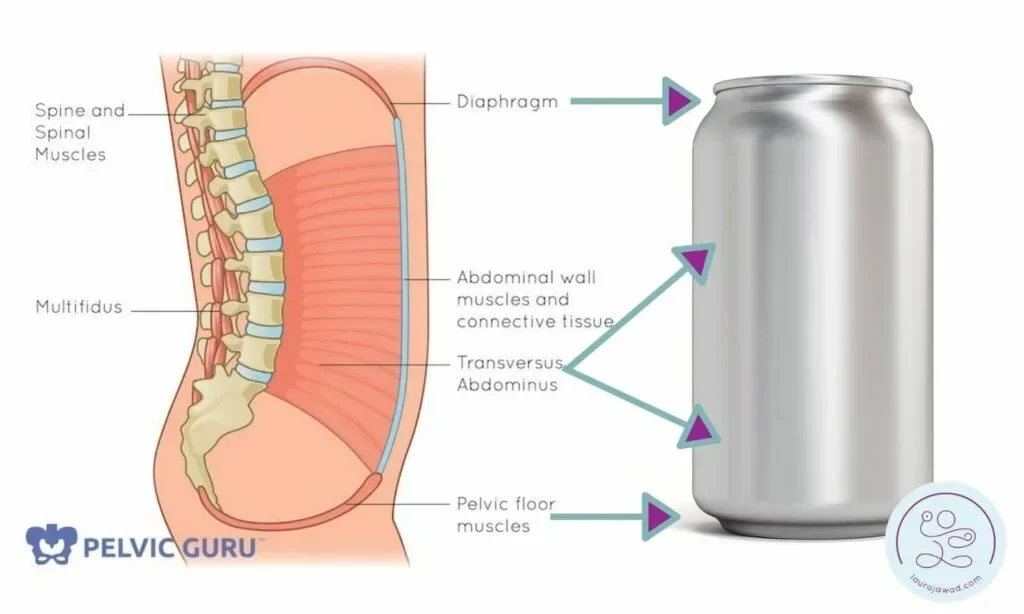
Image courtesy of laurajawod.com
Think of it like a canister. The diaphragm sits at the top. The pelvic floor sits at the bottom, and your deep abdominals wrap around the middle.
For this system to function efficiently, these structures must work in synchrony—and breath is the mechanism that coordinates them.
The Relationship Between Breath and Core
Your diaphragm and your deep core are directly connected. When you inhale, your diaphragm lowers and your core gently expands. When you exhale, your diaphragm lifts and your deep abdominals naturally engage.
This response creates stability, and an adaptable system capable of supporting movement.
When this relationship is disrupted, such as through breath holding, abdominal flexing or pushing, or shallow chest breathing, the system becomes less efficient. The body may then rely on compensatory strategies, including overuse of the hip flexors, superficial abdominal muscles, the lower back or in your neck.
How This Affects Your Pilates Practice
In a Pilates context, inefficient breathing patterns can alter movement quality.
When core function is coordinated with the correct breath, you are better able to:
Maintain lumbopelvic stability — Stabilizing your spine, finding the deeper core connection
Distribute load more effectively — Moving my with more control, avoiding unnecessary tension
This is particularly relevant in both reformer and mat work, where control and alignment are foundational. This also allows movement to resonate where it is supposed to in the body.
Practical Application in Class
All of these physiology terms are complex, and you don’t need to overcomplicate it.
Start here:
Inhale to prepare and expand
Exhale to facilitate movement and support
Rather than forcing abdominal contraction, the goal is to allow the exhale to naturally recruit the deep stabilizing system.
The sensation should be one of support rather than rigidity.
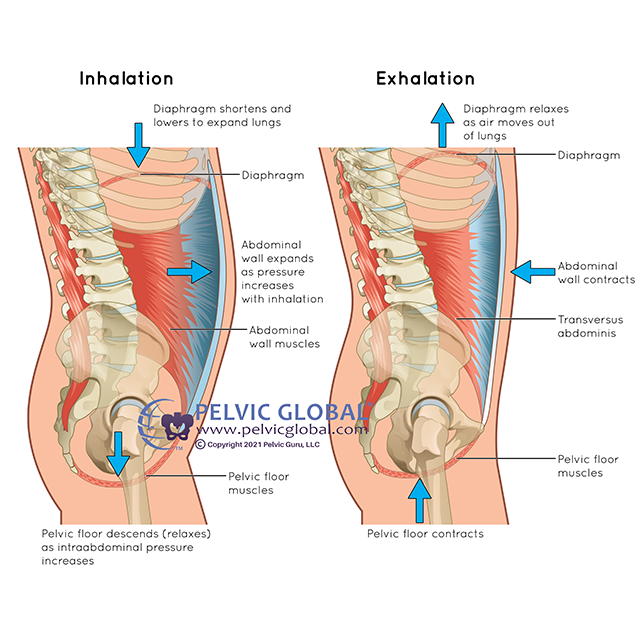
Image Courtesy of pelvicglobal.com
Closing Notes
Understanding the role of breath within the core system provides a more accurate framework for how Pilates functions as a method.
Rather than emphasizing effort alone, it highlights coordination, timing, and internal awareness as key drivers of progress.
When breath and movement are aligned, the body is able to access a deeper level of support and efficiency—ultimately leading to more effective and sustainable results.
